Geography
Kyoto Prefecture is located in the Kyoto Trench, in the central part of Honshu, the largest Japanese island in the Kansai region, also called Kinki. Its capital is the city of Kyoto, whose population exceeds one million people. The territory of the prefecture has access to the Sea of Japan. The climate here is mild and humid, with snowless winters, except in that part of the prefecture that faces the sea;
History
The territory of the prefecture has been inhabited since ancient times, since the Jomon period. In 784, Emperor Kammu moved the country's capitals from Nara and ordered the construction of a new capital in the Kyoto Basin, calling it Heian-kyō, meaning "capital of the world." Another name that the city received became known throughout the world: Kyoto, which means “Western Capital”. Like Nara, Kyoto was built according to a single plan, in the image and likeness of the then capital of China, the city of Changyan. For eleven centuries, Kyoto was the capital of Japan and the imperial court was located here. Moreover, during this time, the real capital functions were often performed by those cities where the shogun’s headquarters was located, in particular, Kamakura and Edo. With the beginning of the Meiji era and the end of the Tokugawa shogunate in 1868, the capital was officially moved from Kyoto to Edo, which from then on became known as Tokyo, meaning "Eastern Capital".
Culture, attractions
and entertainment
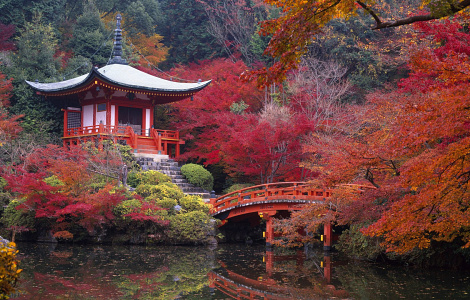
Kyoto is figuratively called the “city of a thousand temples,” although in fact there are over one and a half thousand Buddhist temples and Shinto shrines and idols located here. The entire territory of historical Kyoto belongs to the UNESCO World Heritage Site, which is a unique world practice.
The city is divided into several districts - Central, Eastern, Southern, Western and Northern Kyoto. Each of them contains a number of architectural structures, streets and neighborhoods that are important historical attractions.
In Central Kyoto is the Gosho Imperial Palace, the former residence of the Japanese imperial family, which can only be visited by prior arrangement. Not far from it is Nijo Castle, erected as the residence of the founder of the Tokugawa shogunate, Ieyasu Tokugawa in 1603, at the very beginning of the Edo era. This majestic castle, built in the Momoyama style, was designed to rival the Gosho Palace in scale and beauty. The Buddhist temples of Nishihogenji and Higashihongenji are also located in this area. The Amidado Hall at Nishihogenji Temple is dedicated to Amida Buddha.
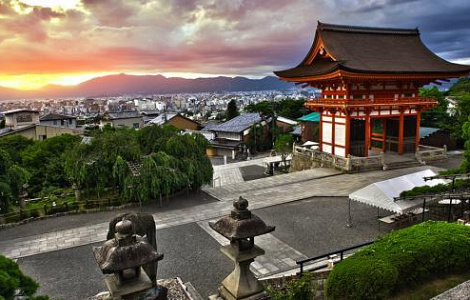
The Higashiyama Historic District in East Kyoto recreates the ancient atmosphere of the city with its narrow picturesque streets and ancient temples. In the same area is the famous Kyoto temple Kiyomizudera - “Temple of Pure Water”. It was founded back in 780. The water in this temple, according to local belief, has healing powers. In the eastern part of the city there is another famous temple, Sanjusangendo, which is the longest wooden structure in Japan with a length of 120 meters. In the main hall there is a large statue of the goddess Kannon the Merciful, another incarnation of the Buddha. And the famous Philosopher's Path, which is a road lined with cherry blossoms, leads from the elegant Silver Pavilion located in the traditional Japanese garden of Ginkakuji, to the most important temple of Zen Buddhism in Japan, Nanzenji. Also in Eastern Kyoto is the legendary historical quarter of Gion, which in the Middle Ages had a reputation as an entertainment district, where geishas also lived. In July, the annual Gion Matsuri festival is held here, perhaps officially considered the largest festival in Japan.
In Northern Kyoto, one should highlight the graceful Kinkakuji - the Golden Pavilion, reflecting in Kyokochi, the “mirror lake”. This is also a temple of the Zen sect, it was erected at the beginning of the fifteenth century and is also known as the Rokuon-ji Temple. Also in this area are the imperial villas of Shukaguin and Katsura. The world famous Ryoanji rock garden is also located here, with fifteen stones on white gravel, one of which is always hidden from the view of the visitor.
In Western Kyoto, Saihoji, the “Temple of Moss”, or Kokedera, is of undoubted interest. It was previously a Shinto shrine, but was later converted into a Buddhist temple. In addition, there is also the scenic Arashiyama district, a park-like area on the outskirts of the city famous for its bamboo groves and small temples.
South Kyoto is home to the Fushimi Inari Shinto Shrine, which is the most famous shrine to the rice god Inari. There are also many statues of kitsune foxes here, as they were his messengers.
Kyoto is also home to Japan's oldest kabuki theater, Minamiza, and the Kimono Museum.
The prefecture is also home to one of the three most beautiful places in Japan, Amanohashidate, along with Matsushima and Miyajima. Translated as “sky bridge”, “Amanohashidate” is a sand spit in Miyazu Bay, famous for its scenic views. According to Shinto mythology, it was here that the gods created the Japanese islands. Amanoshidate is located two hours from Kyoto by local express train.
You can get to Kyoto Station from Tokyo by the Shinkansen super express train, which takes about three hours.




 Top
Top